
What you will learn
- What DNS, DHCP, file, print, mail, web and database servers do
- AAA, syslog and NTP, and why accurate time matters
- Spam gateways, UTM appliances, load balancers and proxy servers
- What SCADA is and why it is isolated
- How to secure IoT devices
PRACTICE TESTS
Ready to drill it?
Practice tests for CompTIA A+ Core 1 and Core 2, every answer explained and checked against published sources. $19.95 for 30 days, plus sales tax where it applies; one payment, nothing renews.
See the 30-day passCheat sheet
Everything in this lesson on one page. Free to save, print and share.
Download the cheat sheet (PNG)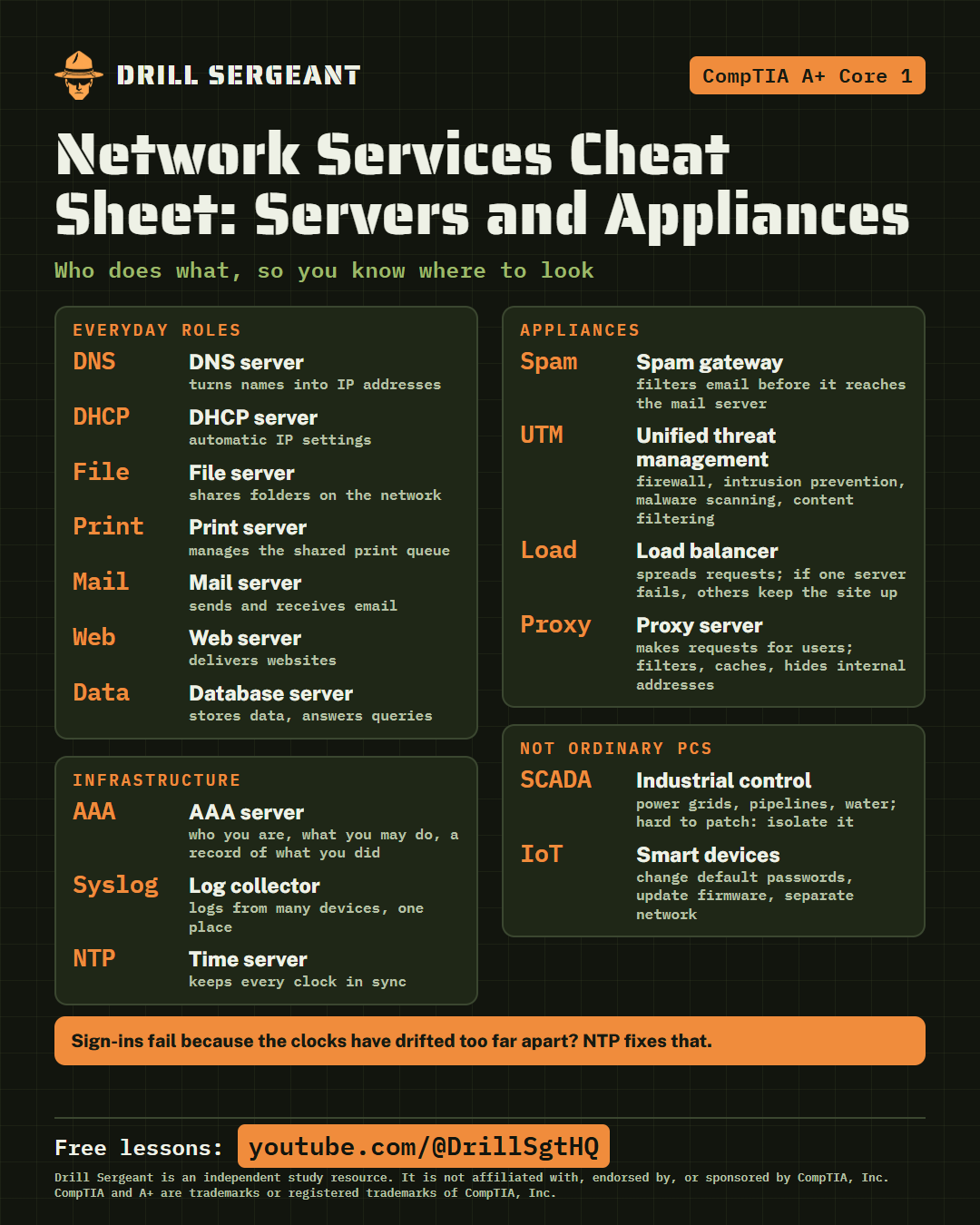
Cheat sheet as text
Network Services Cheat Sheet: Servers and Appliances
Who does what, so you know where to look
Everyday roles
- DNS — DNS server: turns names into IP addresses
- DHCP — DHCP server: automatic IP settings
- File — File server: shares folders on the network
- Print — Print server: manages the shared print queue
- Mail — Mail server: sends and receives email
- Web — Web server: delivers websites
- Data — Database server: stores data, answers queries
Infrastructure
- AAA — AAA server: who you are, what you may do, a record of what you did
- Syslog — Log collector: logs from many devices, one place
- NTP — Time server: keeps every clock in sync
Appliances
- Spam — Spam gateway: filters email before it reaches the mail server
- UTM — Unified threat management: firewall, intrusion prevention, malware scanning, content filtering
- Load — Load balancer: spreads requests; if one server fails, others keep the site up
- Proxy — Proxy server: makes requests for users; filters, caches, hides internal addresses
Not ordinary PCs
| Key | Meaning | Note |
|---|---|---|
| SCADA | Industrial control | power grids, pipelines, water; hard to patch: isolate it |
| IoT | Smart devices | change default passwords, update firmware, separate network |
Sign-ins fail because the clocks have drifted too far apart? NTP fixes that.
Chapters
Exam objectives covered
- Core 1 (220-1201) objective 2.3, Networking
Transcript
Read the full lesson narration
Everyday server roles
Behind every working network, servers and appliances are quietly doing jobs. Here's who does what, so you know where to look when something stops working.
Start with the everyday server roles. A DNS server turns names into IP addresses. A DHCP server hands out IP settings automatically. A file server shares folders across the network, and a print server manages the print queue for shared printers. A mail server sends and receives email. A web server delivers websites. And a database server stores data, and answers the queries that applications send it.
AAA, syslog and NTP
Three more roles keep the network running safely. The AAA server handles authentication, authorization, and accounting: who you are, what you may do, and a record of what you did, often using RADIUS or TACACS+. A syslog server collects log messages from many devices in one place. And an NTP server, using the Network Time Protocol, keeps every clock in sync, which matters because sign-ins and log timestamps depend on accurate time.
Spam gateways, UTM, load balancers, proxies
Internet appliances sit at the edge of the network. A spam gateway filters email before it reaches the mail server. Unified threat management, or UTM, combines a firewall, intrusion prevention, malware scanning, and content filtering in one box. A load balancer spreads requests across several servers, so if one fails, the others keep the site running. And a proxy server makes requests on behalf of users, so it can filter content, cache pages, and hide internal addresses.
SCADA and IoT
Finally, systems that aren't ordinary computers. SCADA, supervisory control and data acquisition, runs industrial equipment like power grids, pipelines, and water systems. It's often old, and hard to patch, so it's kept on an isolated network. And Internet of Things, or IoT, devices, like smart thermostats, cameras, and speakers, are convenient but often weakly secured. Change their default passwords, keep their firmware updated, and put them on a separate network.
Quick drill and recap
Drill time. Say the answer before I do. Every switch and firewall must send its logs to one place. Which server? A syslog server. Sign-ins fail because the clocks have drifted too far apart. Which service fixes that? NTP. One website runs on four servers, and traffic must be spread across them. Which device? A load balancer. A small office wants a firewall, malware scanning, and content filtering in one box. What is it? A UTM appliance. A water plant's control system runs on an old computer that can't be patched. What kind of system is it? SCADA.
Lock in these four. One. Everyday roles: DNS, DHCP, file, print, mail, web, and database. Two. Infrastructure: AAA for access, syslog for logs, and NTP for time. Three. Appliances: spam gateways, UTM, load balancers, and proxies. Four. SCADA and IoT: isolate them, update them, and change the defaults.
That's network services. Now go prove it. Practice questions are waiting for you in Drill Sergeant.
PRACTICE TESTS
Ready to drill it?
Practice tests for CompTIA A+ Core 1 and Core 2, every answer explained and checked against published sources. $19.95 for 30 days, plus sales tax where it applies; one payment, nothing renews.
See the 30-day passRelated lessons
Found a mistake in a lesson? Email support@drillsgthq.com with the lesson and what is wrong.
Drill Sergeant is an independent study resource. It is not affiliated with, endorsed by, or sponsored by CompTIA, Inc. CompTIA and A+ are trademarks or registered trademarks of CompTIA, Inc.