
What you will learn
- UTP vs STP, and what Cat 5e, 6, 6a and 8 can carry
- T568A vs T568B, and straight-through vs crossover cables
- Coax with F-type connectors, plenum-rated and direct burial cable
- Single-mode vs multimode fiber, and ST, SC and LC connectors
- RJ45, RJ11 and punchdown blocks
PRACTICE TESTS
Ready to drill it?
Practice tests for CompTIA A+ Core 1 and Core 2, every answer explained and checked against published sources. $19.95 for 30 days, plus sales tax where it applies; one payment, nothing renews.
See the 30-day passCheat sheet
Everything in this lesson on one page. Free to save, print and share.
Download the cheat sheet (PNG)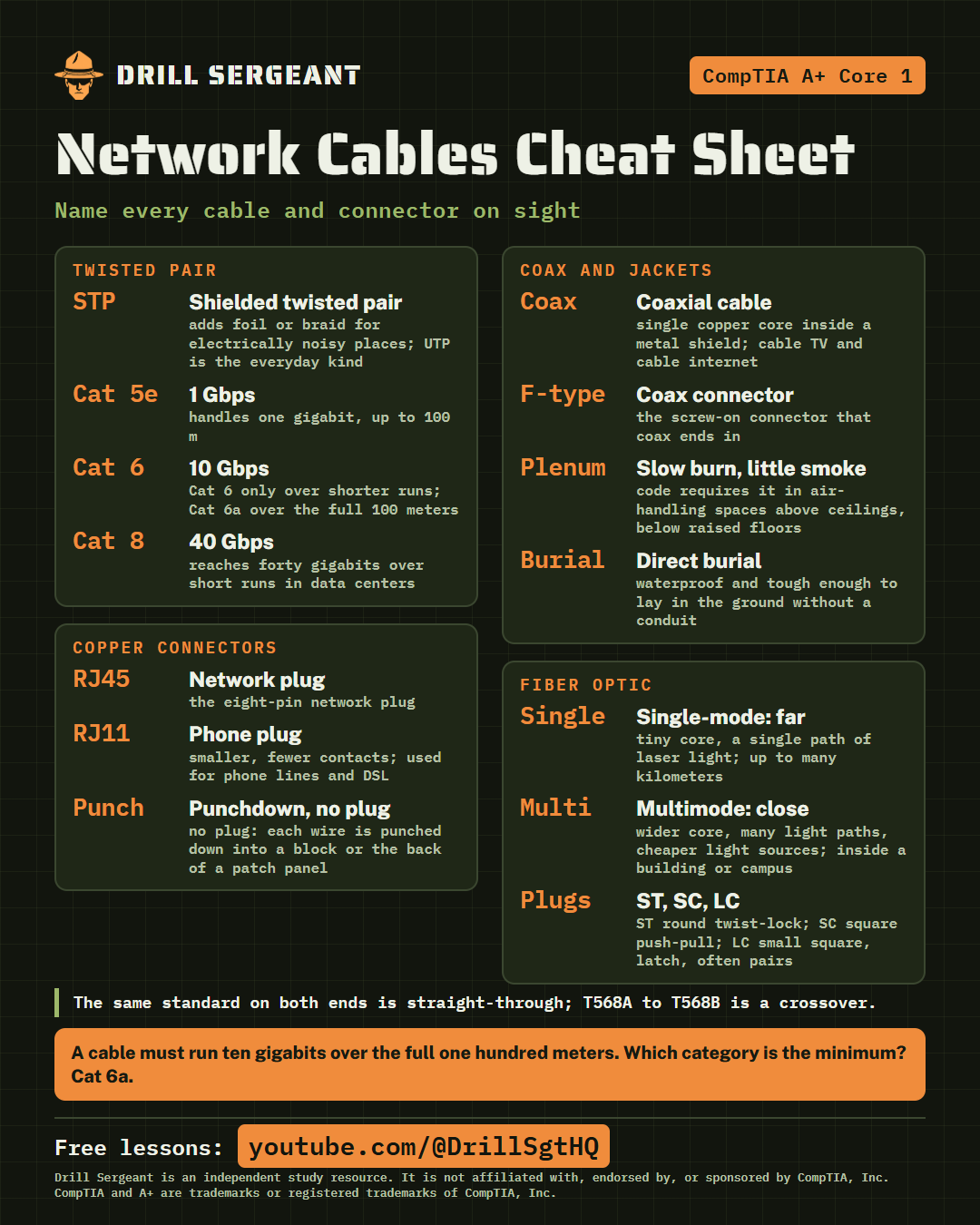
Cheat sheet as text
Network Cables Cheat Sheet
Name every cable and connector on sight
Twisted pair
| Key | Meaning | Note |
|---|---|---|
| STP | Shielded twisted pair | adds foil or braid for electrically noisy places; UTP is the everyday kind |
| Cat 5e | 1 Gbps | handles one gigabit, up to 100 m |
| Cat 6 | 10 Gbps | Cat 6 only over shorter runs; Cat 6a over the full 100 meters |
| Cat 8 | 40 Gbps | reaches forty gigabits over short runs in data centers |
Copper connectors
- RJ45 — Network plug: the eight-pin network plug
- RJ11 — Phone plug: smaller, fewer contacts; used for phone lines and DSL
- Punch — Punchdown, no plug: no plug: each wire is punched down into a block or the back of a patch panel
Coax and jackets
- Coax — Coaxial cable: single copper core inside a metal shield; cable TV and cable internet
- F-type — Coax connector: the screw-on connector that coax ends in
- Plenum — Slow burn, little smoke: code requires it in air-handling spaces above ceilings, below raised floors
- Burial — Direct burial: waterproof and tough enough to lay in the ground without a conduit
Fiber optic
- Single — Single-mode: far: tiny core, a single path of laser light; up to many kilometers
- Multi — Multimode: close: wider core, many light paths, cheaper light sources; inside a building or campus
- Plugs — ST, SC, LC: ST round twist-lock; SC square push-pull; LC small square, latch, often pairs
The same standard on both ends is straight-through; T568A to T568B is a crossover.
A cable must run ten gigabits over the full one hundred meters. Which category is the minimum? Cat 6a.
Chapters
Exam objectives covered
- Core 1 (220-1201) objective 3.2, Hardware
Transcript
Read the full lesson narration
Twisted pair and categories
Every network connection rides on a cable, and every cable ends in a connector. Learn to name them on sight.
Most network cable is twisted pair: four pairs of copper wires, twisted to cancel interference. Unshielded twisted pair, or UTP, is the everyday kind. Shielded twisted pair, or STP, adds foil or braid for electrically noisy places, like near motors. The category sets the speed. Cat 5e handles one gigabit. Cat 6 handles ten gigabits, but only over shorter runs. Cat 6a handles ten gigabits over the full one hundred meters. And Cat 8 reaches forty gigabits over short runs in data centers.
T568A, T568B, straight-through and crossover
Each end of the cable follows a wiring standard: T568A or T568B. The two differ only by swapping the orange and green pairs. Use the same standard on both ends for a straight-through cable, the normal kind. Use A on one end and B on the other for a crossover cable, which older devices needed to connect directly to each other. Most ports today sort this out automatically.
Coax, plenum and direct burial
Coaxial cable has a single copper core inside a metal shield. It carries cable TV and cable internet, and ends in a screw-on F-type connector. Two jacket ratings matter too. Plenum-rated cable burns slowly and makes little smoke, and fire codes require it in the air-handling spaces above ceilings and below raised floors. Direct burial cable is waterproof and tough enough to lay in the ground without a conduit.
Fiber: single-mode, multimode, ST/SC/LC
Fiber optic cable carries light instead of electricity, so electrical interference can't touch it, and it runs much farther. Single-mode fiber has a tiny core that carries a single path of laser light, for long distances, up to many kilometers. Multimode fiber has a wider core, where light takes many paths, and uses cheaper light sources, for shorter runs inside a building or a campus. Fiber connectors come in three common shapes: ST, a round twist-lock; SC, a square push-pull; and LC, a small square with a latch, often in pairs.
RJ45, RJ11 and punchdown blocks
Last, the copper connectors. RJ45 is the eight-pin network plug. RJ11 is smaller, with fewer contacts, and is used for phone lines and DSL. And in the wiring closet, cables don't get plugs at all: each wire is punched down into a punchdown block, like a one ten block, or the back of a patch panel.
Quick drill and recap
Drill time. Say the answer before I do. A cable must run ten gigabits over the full one hundred meters. Which category is the minimum? Cat 6a. A run passes through the air space above a drop ceiling. What kind of cable jacket does code require? Plenum-rated. A link must cover twenty kilometers between buildings. Which kind of fiber do you use? Single-mode. Coax for cable TV needs a screw-on connector. Which type is it? An F-type connector. A patch cable is wired T568A on one end and T568B on the other. What kind of cable is it? A crossover cable.
Lock in these four. One. Twisted pair by category, 5e to 8, and STP for noisy places. Two. The same standard on both ends is straight-through; A to B is a crossover. Three. Coax uses F-type; plenum goes above ceilings; direct burial goes in the ground. Four. Single-mode goes far, multimode stays close, with ST, SC, and LC connectors.
That's network cables and connectors. Now go prove it. Practice questions are waiting for you in Drill Sergeant.
PRACTICE TESTS
Ready to drill it?
Practice tests for CompTIA A+ Core 1 and Core 2, every answer explained and checked against published sources. $19.95 for 30 days, plus sales tax where it applies; one payment, nothing renews.
See the 30-day passRelated lessons
Found a mistake in a lesson? Email support@drillsgthq.com with the lesson and what is wrong.
Drill Sergeant is an independent study resource. It is not affiliated with, endorsed by, or sponsored by CompTIA, Inc. CompTIA and A+ are trademarks or registered trademarks of CompTIA, Inc.