
What you will learn
- 110-120 VAC vs 220-240 VAC, and auto-switching supplies
- What the 12, 5 and 3.3 volt outputs power
- The 20+4 pin connector and the CPU, PCIe and SATA leads
- Modular vs redundant power supplies
- How to size wattage, and what the 80 PLUS levels mean
PRACTICE TESTS
Ready to drill it?
Practice tests for CompTIA A+ Core 1 and Core 2, every answer explained and checked against published sources. $19.95 for 30 days, plus sales tax where it applies; one payment, nothing renews.
See the 30-day passCheat sheet
Everything in this lesson on one page. Free to save, print and share.
Download the cheat sheet (PNG)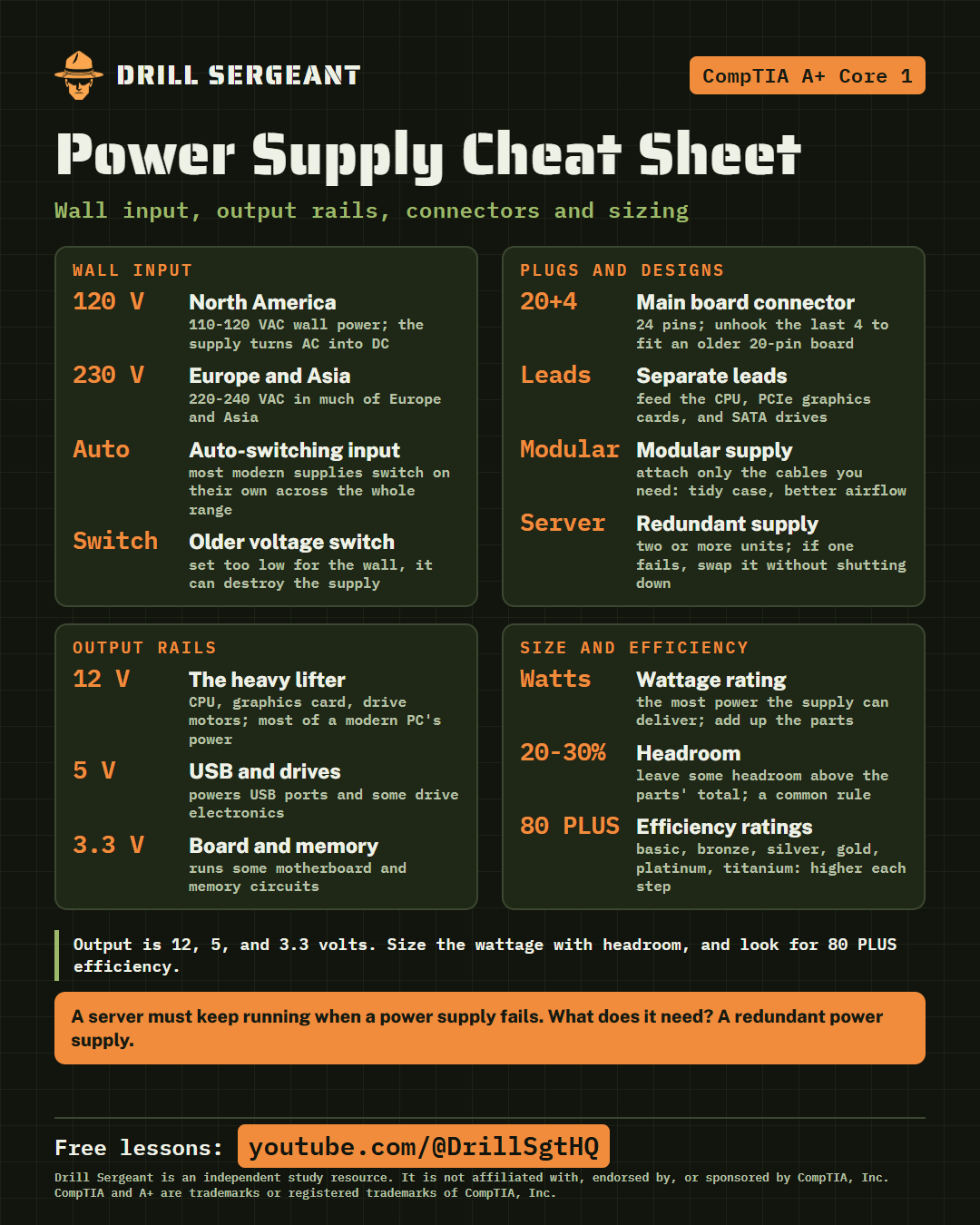
Cheat sheet as text
Power Supply Cheat Sheet
Wall input, output rails, connectors and sizing
Wall input
- 120 V — North America: 110-120 VAC wall power; the supply turns AC into DC
- 230 V — Europe and Asia: 220-240 VAC in much of Europe and Asia
- Auto — Auto-switching input: most modern supplies switch on their own across the whole range
- Switch — Older voltage switch: set too low for the wall, it can destroy the supply
Output rails
| Key | Meaning | Note |
|---|---|---|
| 12 V | The heavy lifter | CPU, graphics card, drive motors; most of a modern PC's power |
| 5 V | USB and drives | powers USB ports and some drive electronics |
| 3.3 V | Board and memory | runs some motherboard and memory circuits |
Plugs and designs
- 20+4 — Main board connector: 24 pins; unhook the last 4 to fit an older 20-pin board
- Leads — Separate leads: feed the CPU, PCIe graphics cards, and SATA drives
- Modular — Modular supply: attach only the cables you need: tidy case, better airflow
- Server — Redundant supply: two or more units; if one fails, swap it without shutting down
Size and efficiency
- Watts — Wattage rating: the most power the supply can deliver; add up the parts
- 20-30% — Headroom: leave some headroom above the parts' total; a common rule
- 80 PLUS — Efficiency ratings: basic, bronze, silver, gold, platinum, titanium: higher each step
Output is 12, 5, and 3.3 volts. Size the wattage with headroom, and look for 80 PLUS efficiency.
A server must keep running when a power supply fails. What does it need? A redundant power supply.
Chapters
Exam objectives covered
- Core 1 (220-1201) objective 3.6, Hardware
Transcript
Read the full lesson narration
AC input: 120 vs 230 volts
Every part in the PC runs on power from one box. Pick the right supply, and it runs quietly for years. Pick the wrong one, and nothing else matters.
A power supply turns AC from the wall into the DC the parts need. Wall power depends on the country: one hundred ten to one hundred twenty volts in North America, and two hundred twenty to two hundred forty volts in much of Europe and Asia. Most modern supplies switch automatically, across that whole range. Some older ones have a voltage switch on the back, and setting it too low for the wall can destroy the supply.
12, 5 and 3.3 volt outputs
On the output side, there are three main voltages. Twelve volts is the heavy lifter: it feeds the CPU, the graphics card, and drive motors. Five volts powers USB ports and some drive electronics. And three point three volts runs some motherboard and memory circuits. Most of a modern PC's power comes from the twelve volt rail.
The 20+4 pin connector
The main motherboard connector has twenty four pins. It's called twenty plus four, because the last four pins can unhook to fit older twenty pin boards. Separate leads feed the CPU, PCIe graphics cards, and SATA drives.
Modular and redundant supplies
Two designs make life easier. A modular power supply lets you attach only the cables you need, so the case stays tidy and air flows better. A redundant power supply puts two or more units in one server, so if one fails, the other keeps it running, and you can swap the failed unit without shutting down.
Wattage and 80 PLUS efficiency
Finally, size and efficiency. The wattage rating is the most power the supply can deliver, so add up the parts, and leave some headroom; twenty to thirty percent is a common rule. Efficiency is how much wall power becomes useful power instead of heat. The eighty plus ratings, from the basic level through bronze, silver, gold, platinum, and titanium, certify higher efficiency at each step.
Quick drill and recap
Drill time. Say the answer before I do. A PC must work on both North American and European wall power. What input feature matters? Auto-switching input. Which output voltage feeds the CPU and the graphics card? Twelve volts. A server must keep running when a power supply fails. What does it need? A redundant power supply. A builder wants only the cables they use, for better airflow. Which kind of supply fits? A modular power supply. An older board has a twenty pin connector. Can a twenty plus four supply power it? Yes, by unhooking the extra four pins.
Lock in these four. One. Input is about one hundred twenty or two hundred thirty volts, and most supplies switch automatically. Two. Output is twelve, five, and three point three volts. Three. Twenty plus four pins, modular cables, and redundant units for servers. Four. Size the wattage with headroom, and look for eighty plus efficiency.
That's power supplies. Now go prove it. Practice questions are waiting for you in Drill Sergeant.
PRACTICE TESTS
Ready to drill it?
Practice tests for CompTIA A+ Core 1 and Core 2, every answer explained and checked against published sources. $19.95 for 30 days, plus sales tax where it applies; one payment, nothing renews.
See the 30-day passRelated lessons
Found a mistake in a lesson? Email support@drillsgthq.com with the lesson and what is wrong.
Drill Sergeant is an independent study resource. It is not affiliated with, endorsed by, or sponsored by CompTIA, Inc. CompTIA and A+ are trademarks or registered trademarks of CompTIA, Inc.